
California Senate Bill 707 Implementation Tracker.
CA SB 707 — Responsible Textile Recovery Act — California’s Textile EPR Program Development Phase
Last Updated: October 9th, 2026
This California Senate Bill 707 tracker from American Circular Textiles (AMCIRC®) summarizes key implementation milestones, emerging questions, and early developments related to the implementation of California’s Responsible Textile Recovery Act (SB 707) as the program moves from legislation to implementation.
This tracker is intended to support general understanding of SB 707 implementation. Companies with specific questions about applicability, compliance obligations, or legal interpretation may also wish to consult counsel. The tracker is intended to provide companies, policymakers, and other stakeholders with a clear reference point as the program moves from legislative adoption into the program development phase. It will be updated periodically as new information becomes available.
-
October 9, 2026
Third regulatory concept workshop scheduled, First and Second have been held
CalRecycle has announced that the third Textile Stewardship Informal Regulatory Concepts Workshop will be held on Thursday, November 12, 2026 from 10:00 am to 5:00 p.m. PT at CalREcycle headquarters.
Topics to be discussed at the workshop include:
Producer Responsibility Plan
Contingency Plan
Plan Termination
Plan Revocation and Cessation of Producer Responsibility Organization Status
Annual Reports
The meeting notice can be found here. Interested parties can participate in person, via Zoom, or by watching the livestream of the workshop.
Prior Workshops
Informal Regulatory Concepts workshops were also held on August 13 and September 29, 2026. At each workshop, CalRecycle shared discussion documents and asked for questions and comments from the public.
The September 29 workshop covered Responsible End Markets, Reuse, and Repair;
Convenient Collection System; and Producer Identification and Exemptions. The comment period for the September 29, 2026 workshop will close on Tuesday, October 13, 2026.
More information on the September 29 workshop, including the discussion documents and the presentation slides can be found on the public meeting notice here.
More information on the August 13 workshop can be found on the public meeting notice here.
Hearing set in Legal Challenge to CalRecycle’s selection of Landbell USA as Textile PRO
On March 27, 2026, the American Apparel and Footwear Association (AAFA) filed a challenge to CalRecycle’s recent selection of Landbell USA to serve as the PRO for California’s Textile EPR Program in Sacramento County Superior Court.
AAFA contends that CalRecycle failed to follow the statute in its selection of Landbell USA and has asked that the Court direct CalRecycle to vacate its decision selecting Landbell USA as the PRO and to reopen the PRO selection process consistent with the standards the state legislature provided in the statute.
After AAFA unsuccessfully sought a preliminary injunction, a hearing on the original challenge was scheduled for March 12, 2027.
This tracker will be updated as new information becomes available.
April 8, 2025Landbell USA Producer Registration Portal Opened
At the SB 707 Textile Needs Assessment Workshop on April 7, 2026, Landbell USA Executive Director Patrick Gibbs announced that producer registration for the Responsible Textile Recovery Act of 2024 (SB 707) is now open. You can find registration information at https://landbellusa.com/ or go directly to the registration link.
Under the law, obligated producers of apparel, footwear, or textile articles in California must join the approved PRO by July 1, 2026. The 2026–2027 registration cycle, as stated in the Landbell USA PRO application, features a flat annual fee of $1,000 per producer to fund the "Pre-Implementation" phase, including the statewide Needs Assessment and system development.
Questions about registration or Landbell USA's implementation of the Responsible Textile Revovery Act of 2024 can be directed to landbellusa.support@landbellgroup.com.
-
Public stakeholder engagement:
October 13, 2026: The public comment period for the September 29, 2026 Textile Stewardship Informal Regulatory Concepts Workshop will close on Tuesday, October 13, 2026.
More information on the September 29 workshop, including the discussion documents and the presentation slides can be found on the public meeting notice here.
November 12, 2026: CalRecycle’s third Textile Stewardship Informal Regulatory Concepts Workshop will occur on Thursday, November 12, 2026 from 10:00 a.m. to 5:00 p.m. PT. The meeting notice can be found here. Interested parties can participate in person, via Zoom, or by watching the livestream of the workshop.
Topics to be discussed at the workshop include:
Producer Responsibility Plan
Contingency Plan
Plan Termination
Plan Revocation and Cessation of Producer Responsibility Organization Status
Annual Reports
SB 707 At-a-Glance.
California’s Responsible Textile Recovery Act (SB 707) establishes an extended producer responsibility framework for textiles and apparel sold in the state.
In March 2026, CalRecycle designated Landbell USA as the Producer Responsibility Organization (PRO) responsible for developing the program.
Covered producers with more than $1 million in annual global sales that sell apparel or textile products in California will be required to register with the PRO beginning July 1, 2026. Covered products include apparel and other textile articles sold in California, with specific product definitions to be clarified through the rulemaking and program development process.
Over the next several years, the PRO will conduct a needs assessment, regulators will undertake rulemaking, and the program plan will be developed and approved. Full program implementation is scheduled for July 1, 2030.
What This Means Right Now.
With the PRO now designated, California's textile extended producer responsibility program is entering the early program development phase. While full operational requirements are still years away, the decisions being made now will shape how the system ultimately functions.
For companies selling textiles and apparel into California, the immediate implications are primarily strategic rather than operational. Covered producers with more than $1 million in global annual sales will be required to register with the Producer Responsibility Organization beginning July 1, 2026. Producer fees are not expected to begin until full program implementation in 2030, but registration is the first concrete compliance requirement on the horizon, and missing it could limit a company's ability to participate in shaping program rules during the critical early phase.
This is the window that matters. EPR programs are rarely static after launch. The frameworks established during program development: how fees are structured, how collection infrastructure is prioritized, how performance metrics are defined tend to persist. Producers who engage early have historically had more influence over outcomes than those who wait for final rules.
In practical terms, that starts with confirming whether your products and revenue meet the covered producer threshold. The $1 million global annual sales figure is broad, and many brands that don't think of themselves as large producers will qualify.
In the near term, industry participants are watching how the PRO structures early engagement, how infrastructure investment priorities get established, and how program costs may ultimately be allocated. Companies that are monitoring these developments now will be better prepared when operational requirements come into effect.
Organizations interested in following SB 707 implementation developments or engaging with AMCIRC as the program evolves can contact: policy@americancirculartextiles.com
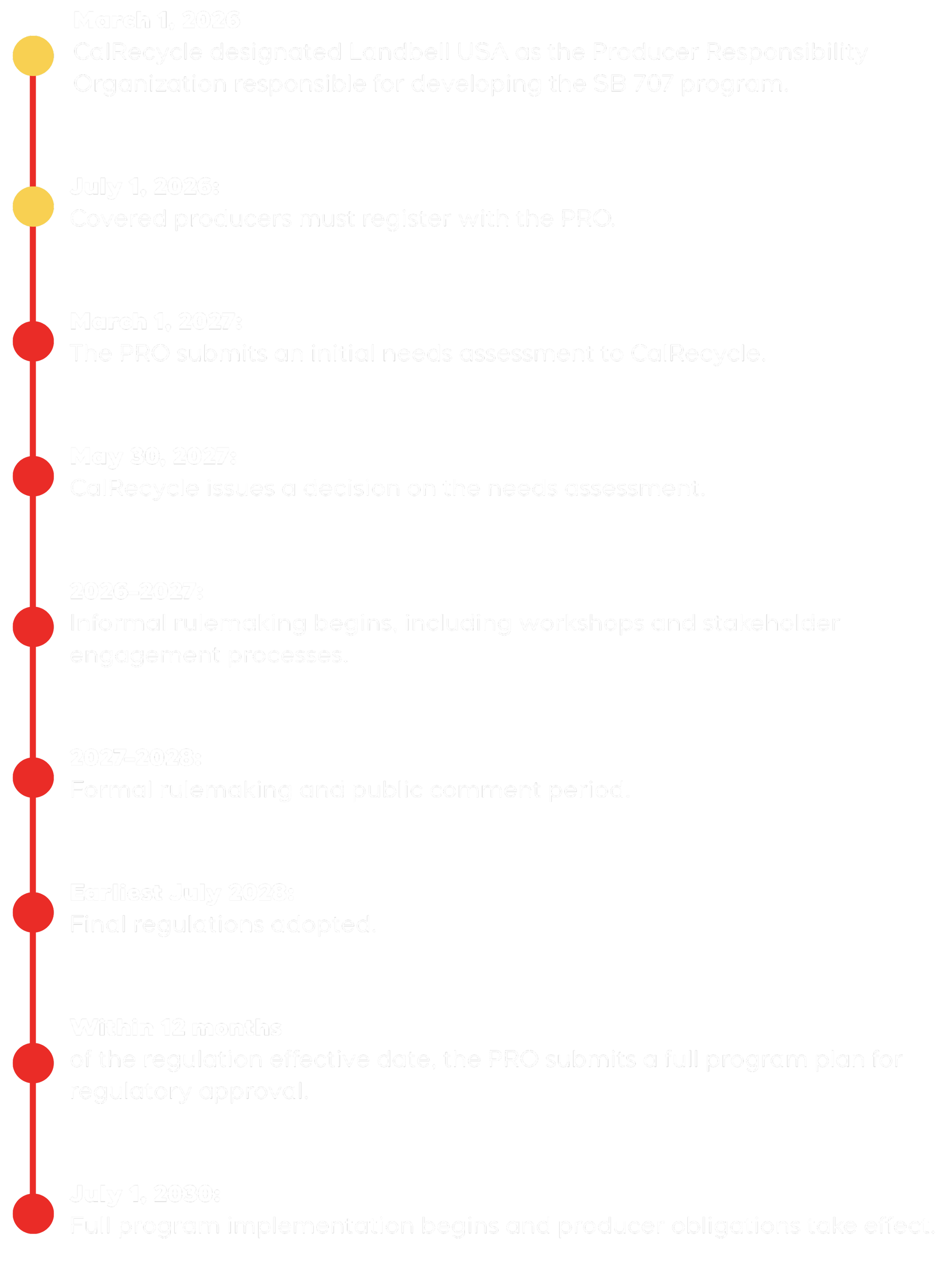
Implementation Timeline.
The following milestones outline the expected development process for the SB 707 program.
Current Stage — Program Development Begins
Implementation Questions.
As SB 707 moves into the program development phase, a number of practical implementation questions are beginning to emerge across the textile value chain. American Circular Textiles will update this section as additional guidance becomes available from the Producer Responsibility Organization and regulators.
-
Under SB 707, a “producer” generally refers to the company responsible for placing a covered textile or apparel product on the California market. This may include the brand owner, importer, or in some cases the retailer selling the product under its own brand.
Producers with more than $1 million in annual global sales that sell apparel or textile products in California will be required to register with the Producer Responsibility Organization beginning July 1, 2026.
SB 707 applies to apparel and other textile articles sold in California. Covered products include clothing as well as certain household textiles such as bedding, towels, and similar items. The complete list of covered product categories is maintained by CalRecycle and may be further clarified through rulemaking and program development.
Because supply chains in the apparel sector can be complex, the specific determination of who qualifies as the producer may depend on how products are branded, imported, and sold. Additional guidance is expected during the rulemaking and program development process.
-
Producers selling covered textile and apparel products into California are required to register with the PRO by July 1, 2026. You can find registration information at https://landbellusa.com/ or go directly to the registration link.
Under the law, obligated producers of apparel, footwear, or textile articles in California must join the approved PRO by July 1, 2026. The 2026–2027 registration cycle, as stated in the Landbell USA PRO application, features a flat annual fee of $1,000 per producer to fund the "Pre-Implementation" phase, including the statewide Needs Assessment and system development.
Questions about registration or Landbell USA's implementation of the Responsible Textile Revovery Act of 2024 can be directed to landbellusa.support@landbellgroup.com.
-
While producer fees will not begin until full program implementation in 2030, the methodology used to determine producer contributions to the system will be developed during the program design phase.
-
Companies are monitoring how reporting requirements may be structured and what types of operational and material flow data producers and participating service providers may be required to provide.
-
Stakeholders across the textile recovery ecosystem are evaluating how current collection programs, reuse markets, and recycling operations may participate in the statewide system developed under SB 707.
-
The early implementation phase is expected to include stakeholder engagement processes that help inform program design, infrastructure priorities, and operational requirements.
-
In the apparel and textile sector, products may reach the California market through a variety of channels, including brand-owned labels, private label retail programs, importer arrangements, and online marketplaces.
Under SB 707, the entity responsible for placing a covered product on the California market is generally considered the producer. In practice, determining the responsible producer may depend on factors such as brand ownership, import arrangements, and how products are marketed and sold.
Companies operating across multiple business models, including private label retail or marketplace platforms, are therefore monitoring how these structures may be treated as the program development process moves forward.
Additional clarification may emerge through the needs assessment process, stakeholder engagement with the Producer Responsibility Organization, and the state rulemaking process.
Contact.
Organizations following SB 707 implementation or interested in joining these discussions as the program develops may contact: policy@americancirculartextiles.com
Media inquiries: press@americancirculartextiles.com
Key Documents.
Additional guidance and implementation updates will be added as they become available.
Latest Implementation Brief.
About American Circular Textiles.
American Circular Textiles (AMCIRC) is an independent U.S. policy intelligence and engagement platform focused on the regulatory, market, and infrastructure developments shaping textile circularity.
The organization convenes brands, resale platforms, recyclers, technology providers, and other stakeholders to support informed engagement with evolving policy frameworks affecting the textile and apparel sector.